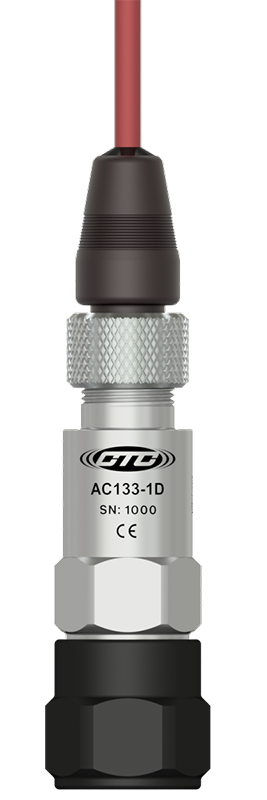
AC133 and MH170-1A Power Pack For High-Temperature, Low-Frequency Applications
Click here to download printer-friendly pdf version
Challenge
When monitoring slow-speed machinery in high-temperature environments, reliability engineers often face a difficult challenge.
The machine may generate valuable low-frequency vibration data, but elevated surface temperatures can exceed the operating limits of standard accelerometers, reducing sensor life and compromising measurement reliability.
Solution
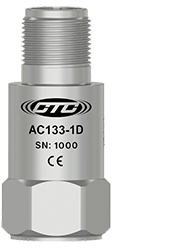
AC133-1D
Low-frequency accelerometer, top exit 2 pin connector, 500 mV/g, ±10% sensitivity tolerance, 121 °C (250 °F) maximum temperature
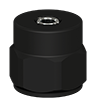
MH170-1A
Accelerometer mounting pad for high-temperature dissipation and electrical isolation, 250 °C (480 °F) maximum temperature
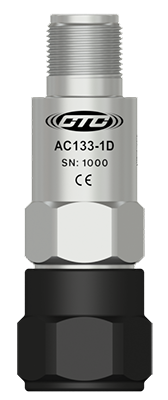
CTC’s AC133 is specifically designed for low-speed machinery, providing a 500 mV/g output and frequency response down to 0.1 Hz.
What makes this combination especially effective is the MH170-1A mounting pad. Designed for extreme environments, the pad can withstand temperatures up to 250 °C (480 °F) and has demonstrated the ability to dissipate up to 169 °C (336 °F) between the machine surface and the mounted sensor during controlled testing. This allows sensors with a maximum operating temperature of 121 °C (250 °F) to be successfully applied on significantly hotter equipment while maintaining long-term reliability.
The MH170-1A also functions as a mechanical low-pass filter, accurately passing vibration frequencies up to approximately 2,300 Hz (+3 dB) while attenuating higher-frequency vibration content. This makes it an excellent solution for low-frequency applications where the primary focus is monitoring slow-speed rotating equipment and overall machine health rather than high-frequency fault detection.
Why It Works
- Protects the accelerometer from excessive machine surface temperatures
- Extends sensor life in high-heat environments
- Preserves critical low-frequency vibration measurements on slow-speed assets
- Mechanically filters unwanted high-frequency vibration content
- Allows one solution to address both thermal and measurement challenges simultaneously
Complete the Installation with High-Temperature Cabling
For applications operating in extreme environments, the sensor and mounting pad are only part of the equation.
CTC’s FEP-jacketed cabling provides excellent high-temperature performance and should be paired with our A2R or V2R connector systems to create a complete monitoring solution capable of withstanding harsh industrial conditions

CB102
Two conductor, red FEP-jacketed, twisted, shielded pair cable, 200 °C (392 °F) maximum temperature

CB111
Two conductor, yellow FEP-jacketed, twisted, shielded pair cable, 200 °C (392 °F) maximum temperature
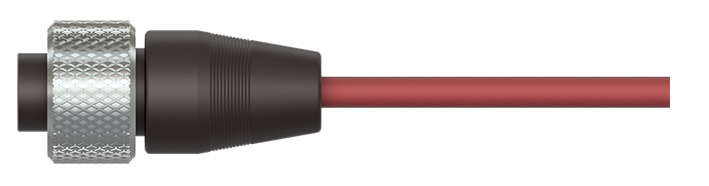
A2R
High-temperature 2-socket MIL-style, PPS molded connector, permanent mount, 200 °C (392 °F) maximum temperature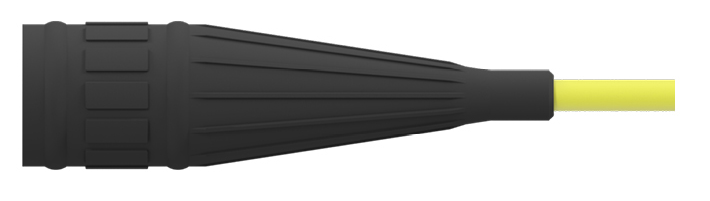
V2R
High-temperature 2-socket MIL-style seal-tight Viton boot connector with PPS insert, permanent mount, 177 °C (350 °F) maximum temperature