Wireless Success Story: SpaceX Installation
Use this link to download the printer-friendly pdf version of this blog post
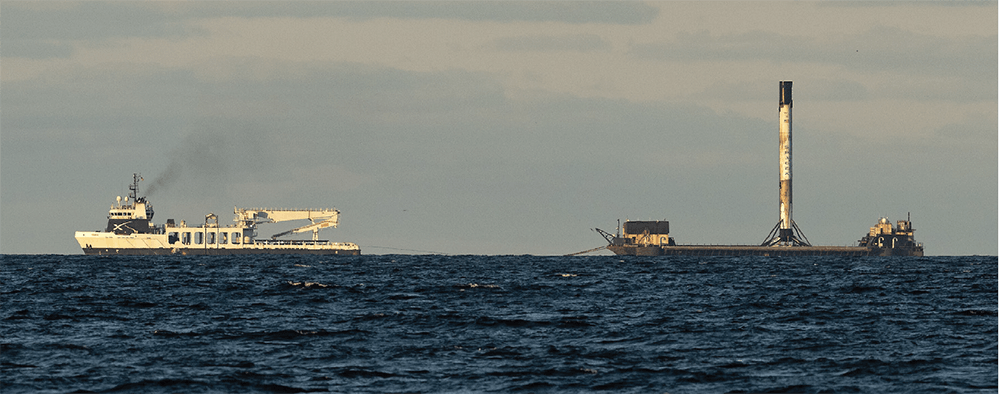
Photo by Bill Ingalls - This image or video was catalogued by NASA Headquarters of the United States National Aeronautics and Space Administration (NASA) under Photo ID: NHQ202210080001., Public Domain, https://commons.wikimedia.org/w/index.php?curid=12753431
The Application
Offshore rocket recovery operations demand reliable equipment performance and minimal downtime. The Bob and Doug recovery vessels, which support SpaceX rocket recovery missions following Starlink launches, rely on critical engine room machinery and crane systems to safely execute operations at sea.
To improve equipment visibility and reliability, CTC Connect Wireless Condition Monitoring was deployed aboard both vessels. Originally built in 2009 and added to the SpaceX fleet in 2021, each vessel is approximately 85 meters (279 ft.) long and 18 meters (59 ft.) wide.
CTC wireless sensors were installed throughout the engine room and crane systems, providing real-time machine condition data to the vessels' automation and monitoring infrastructure.
The Challenge
Critical equipment aboard the vessels experienced intermittent mechanical issues that had the potential to impact offshore operations and maintenance planning.
The maintenance team needed a solution that could monitor equipment health, identify developing faults early, and provide actionable data without relying solely on periodic inspections since failure at sea is not an option.
In addition, machine condition information needed to integrate seamlessly into existing vessel control and monitoring systems.
The CTC Solution
CTC Connect Wireless Condition Monitoring was deployed across both vessels to provide continuous asset health monitoring and early fault detection.
Each vessel was equipped with:
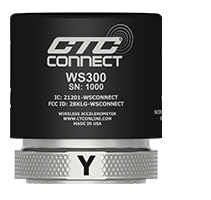
36 × WS300 Wireless Vibration Sensors
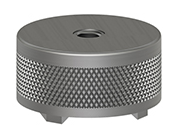
36 × MH214-3A Magnetic Sensor Mounts
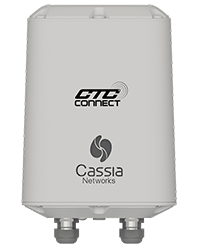
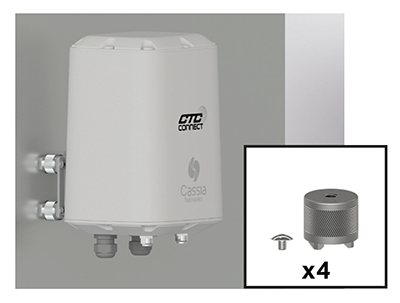
6 x ACCESS2000-MH Gateway Magnet Mounting Kits
Asset Coverage
Of the 36 sensors installed on each vessel:
- 32 sensors monitor critical engine room assets
- 4 sensors monitor the overhead crane system
The wireless monitoring network was integrated directly with Høglund PLCs using Modbus TCP/IP while simultaneously publishing machine condition data via MQTT for monitoring and analytics applications.
Why Modbus TCIP/IP Integration Matters
Many wireless monitoring systems require users to access a separate cloud platform, subscribe to software services, or pay ongoing fees to access their own machine
condition data.
For SpaceX, that approach was not ideal. The vessel already relied on existing Høglund PLCs and automation systems to manage critical marine operations. Rather than introducing another isolated monitoring platform, CTC Connect allowed vibration and temperature data to become part of the vessel's existing operational infrastructure through native Modbus TCP/IP integration.
This architecture provides several advantages:
- Machine health data is available directly within the vessel's control systems
- Condition data can be combined with other operational parameters for improveddecision-making
- Data remains under the owner's control within their existing OT environment
- No recurring software licenses or data access fees
By acting as a Modbus TCP/IP server, CTC Wireless Gateways make sensor data available to the Høglund PLCs exactly like any other operational device on the network. This allows vibration and temperature measurements to be incorporated into existing dashboards, alarms, historian systems, and maintenance workflows. Additionally, the secondary MQTT integration allowed for dynamic data capture and visualization as needed.
Open Data. No Handoff Fees.
A key advantage of the CTC Connect architecture is that SpaceX owns and controls its machine condition data.
Wireless sensor data is delivered directly to the vessel's PLC and monitoring infrastructure through standard industrial protocols such as Modbus TCP/IP and MQTT, eliminating dependency on proprietary cloud platforms or subscription-based data services.
As a result:
- No cloud lock-in
- No per-sensor monitoring fees
- No recurring data access charges
- No charges to transfer machine health data into third-party systems
- Full ownership and accessibility of condition monitoring information
This open architecture allowed SpaceX to integrate condition monitoring data wherever it delivers the most value, while avoiding the ongoing costs often associated with proprietary monitoring ecosystems.